The world of haute couture has always thrived on contrasts—the delicate interplay between tradition and rebellion, refinement and raw energy. Few moments in recent fashion history embody this tension as vividly as Chanel’s audacious twist on its iconic tweed, a fabric long synonymous with timeless elegance. But in a bold stroke of punk irreverence, the house unleashed a collection where studs and spikes clawed their way into the meticulously woven threads, signaling not just an aesthetic shift but a full-blown mutiny against its own heritage.
For decades, Chanel’s tweed suits stood as the ultimate shorthand for polished sophistication. Worn by aristocrats, celebrities, and power women, the fabric was a tactile manifestation of Coco’s vision: structured yet soft, luxurious yet understated. Yet, beneath the surface of this sartorial perfection, a quiet unrest simmered. The punk movement, with its DIY ethos and anti-establishment bravado, had been creeping into high fashion for years—but never before had it infiltrated Chanel’s hallowed halls with such deliberate defiance.
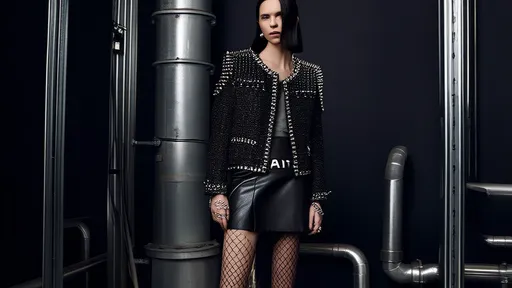
The runway that season was a battleground. Models strode down in tweed jackets that looked familiar at first glance—until the light caught the glint of razor-sharp studs lining the seams. Skirts swung with the weight of hidden grommets, and even the classic chain-stitched hems were punctuated by jagged metal accents. It was as if the ghost of Vivienne Westwood had stormed 31 Rue Cambon, armed with a toolbox of anarchic hardware. The message was clear: Chanel wasn’t just nodding to punk; it was letting punk rewrite its DNA.
Critics were divided. Purists clutched their pearls at what they saw as a desecration of Mademoiselle’s legacy. How could something as coarse as a safety pin share space with hand-rolled hems? Yet others hailed it as a masterstroke—a way to keep tweed relevant for generations weaned on ripped denim and leather jackets. The collection’s brilliance lay in its refusal to choose between extremes. The tweed remained impeccably crafted, the silhouettes undeniably Chanel. But the rebellion was there, sewn into every seam, a whispered "fuck you" to the idea that luxury must always play nice.
What made this punk incursion so potent was its timing. Fashion had been flirting with edge for seasons, but rarely with such intentionality. Here, the studs weren’t mere adornments; they were narrative devices. Each spike functioned like a rupture in the fabric of tradition, a deliberate crack in the veneer of perfection. Even the color palette leaned into the dissonance—classic neutroids slashed with anarchic neon, like a perfectly composed sentence suddenly screaming in all caps.
The accessories amplified the chaos. Quilted handbags, those sacred objects of desire, now dangled heavy metal charms. The iconic CC logo appeared stamped onto battered-looking patches, as if scavenged from a punk club’s backroom. Even the footwear—typically a showcase for sleek sophistication—got the treatment, with stiletto boots wrapped in chains and buckles that clinked with every step. It was luxury, but luxury that didn’t mind getting its hands dirty.
Perhaps most intriguing was how the collection resonated beyond the runway. Street style stars and influencers began DIY-ing their own Chanel pieces, adding safety pins to vintage tweed or distressing the hems of secondhand jackets. In an ironic twist, the house’s foray into punk had sparked a new wave of actual punk behavior—people customizing and defacing their Chanel, something that would’ve been unthinkable a decade prior. The brand’s willingness to embrace this chaos only deepened its cultural cachet.
Behind the scenes, the design team spoke of the collection as a "controlled explosion." Every stud was placed with precision, every frayed edge calculated to look careless without actually being so. This wasn’t rebellion for rebellion’s sake; it was a thoughtful interrogation of what Chanel could be when pushed to its limits. The punk elements served as punctuation marks in a larger story about evolution, a way to honor the past while refusing to be trapped by it.
In the end, the tweed mutiny proved more than a fleeting trend. It marked a turning point for Chanel, proving that even the most storied houses could court anarchy without losing their identity. The studs and spikes weren’t just decorations—they were battle scars, proof that luxury could survive (and thrive) outside its gilded cage. As one critic put it: "This wasn’t just a collection. It was a coup." And like all great coups, its reverberations would be felt long after the last model left the runway.
By /Aug 21, 2025
By /Aug 13, 2025

By /Aug 13, 2025
By /Aug 13, 2025

By /Aug 13, 2025
By /Aug 13, 2025

By /Aug 13, 2025
By /Aug 13, 2025

By /Aug 13, 2025
By /Aug 13, 2025
By /Aug 13, 2025

By /Aug 13, 2025

By /Aug 13, 2025
By /Aug 13, 2025

By /Aug 13, 2025
By /Aug 13, 2025

By /Aug 13, 2025

By /Aug 13, 2025

By /Aug 13, 2025

By /Aug 13, 2025