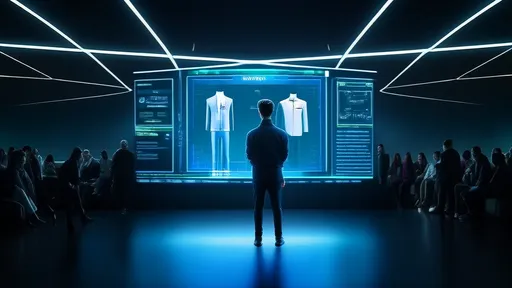
The front row at Shanghai Fashion Week erupted in cheers as the final model strutted down the runway wearing an avant-garde holographic gown - not chosen by the designer, but by 38,000 viewers voting in real-time through their smartphones. This unprecedented moment marked the culmination of "Democratized Runway," an experiment blurring the lines between haute couture and participatory entertainment.
The age of unilateral creative decisions in fashion may be coming to an end. Across major fashion capitals from Milan to Seoul, brands are experimenting with live-streamed "choose the finale" formats where audiences collectively determine which look closes the show. What began as marketing gimmicks during pandemic-era digital fashion weeks has evolved into a legitimate creative movement challenging traditional power structures in the industry.
At the heart of this shift lies China's maturing live commerce ecosystem. Platforms like Douyin and Kuaishou have perfected the art of mass participation through gamified interactions - a technological infrastructure now being repurposed for creative decision-making. During a recent Guo Pei show, viewers could allocate virtual "flowers" to their preferred designs, with the top three looks automatically becoming the show's grand finale sequence.
The psychological impact of this democratization is profound. Fashion historian Eleanor Whitman observes how the voting mechanism creates "instant emotional investment" from participants. "When someone sees 'their' chosen design take the spotlight, it triggers neurological rewards similar to gambling wins - except here they're winning cultural capital rather than money," she explains. This neurological hook has led to staggering engagement metrics, with some shows attracting over 500,000 concurrent voters.
Critics argue this trend represents the commodification of artistic vision. Veteran designer Olivier Lapidus warns that "algorithms shouldn't dictate aesthetics," recalling how his Paris show's planned finale - a delicate hand-beaded cape - lost to a flashy LED-embedded jacket favored by younger voters. Yet even skeptics acknowledge the business potential: shows incorporating voting see 3-5x more social media mentions and 40% longer viewer retention rates.
The technology enabling this revolution is surprisingly nuanced. Beyond simple popularity contests, advanced systems now weigh votes by viewer "fashion credibility scores" - metrics derived from users' historical engagement with fashion content. Some platforms even segment voting power by demographics, ensuring a 45-year-old luxury buyer's input carries different weight than a Gen Z trendspotter's preference.
Perhaps the most fascinating development is the emergence of "crowd-curated storytelling". At a recent Shanghai show by rising label Musefront, the voting didn't simply pick standalone looks but determined an entire narrative arc. Early-round votes established a "romantic rebellion" theme, mid-show selections shaped the color progression from muted to vibrant, and the finale vote resolved whether the collection would end on notes of "hope" or "chaos" - with the latter winning by 52%.
This narrative approach reveals how participatory fashion is evolving beyond surface-level engagement. "We're not just letting people choose hemlines," says Musefront creative director Liang Wei. "We're co-authoring fashion's emotional language with our community." The brand has since incorporated voter commentary into its design process, with phrases like "wearable armor" from the live chat inspiring their next collection.
The commercial implications are equally transformative. Real-time voting generates invaluable consumer data, allowing brands to adjust production plans before fabrics are even cut. When a little-known designer's audience-voted finale went viral last season, pre-orders for that piece exceeded 10,000 units within hours - a previously unimaginable scenario for emerging talent without retail infrastructure.
Educational institutions are taking note. The London College of Fashion recently introduced a "Participatory Design Strategies" module where students must create collections with built-in audience decision points. "Today's designers need fluency in both silhouette construction and interactive mechanics," explains department chair Rachel Dickson. Early projects have yielded intriguing hybrids like a dress whose cut changes based on real-time weather data from voters' locations.
As with any democratization movement, questions about representation persist. While voting systems theoretically allow broader participation, in practice they favor demographics dominant on specific platforms. A luxury brand's older clientele may be underrepresented on Douyin, just as avant-garde tastes get drowned out in mass votes on more mainstream platforms. Some houses now run parallel voting across multiple apps to balance these biases.
The legal landscape is scrambling to catch up. A recent dispute arose when a voter claimed co-ownership rights over a finale design that incorporated her specific suggestions from the live chat. While the case was dismissed, it highlights uncharted territory in creative ownership within participatory systems. Major brands are now implementing blockchain-based attribution systems to track and potentially compensate particularly influential voter contributions.
Looking ahead, the intersection of fashion and interactive technology promises even more radical experiments. Prototype systems using VR allow voters to "walk" alongside models and experience designs from multiple angles before casting ballots. Other shows are testing AI that generates endless design variations in real-time for voters to mix and match - a potentially infinite creative feedback loop between audience and algorithm.
What began as a pandemic stopgap has blossomed into fashion's most consequential digital transformation since the rise of e-commerce. As boundaries between creator and consumer dissolve, the very definition of a "fashion show" is being rewritten - not by editors or buyers, but by millions of fingers tapping screens in collective creative expression. The final walk may no longer belong to the designer alone, but to the crowd that helped shape its every glittering step.
By /Aug 21, 2025
By /Aug 13, 2025
By /Aug 13, 2025
By /Aug 13, 2025
By /Aug 13, 2025
By /Aug 13, 2025
By /Aug 13, 2025
By /Aug 13, 2025
By /Aug 13, 2025
By /Aug 13, 2025
By /Aug 13, 2025

By /Aug 13, 2025
By /Aug 13, 2025
By /Aug 13, 2025

By /Aug 13, 2025
By /Aug 13, 2025
By /Aug 13, 2025

By /Aug 13, 2025

By /Aug 13, 2025

By /Aug 13, 2025
