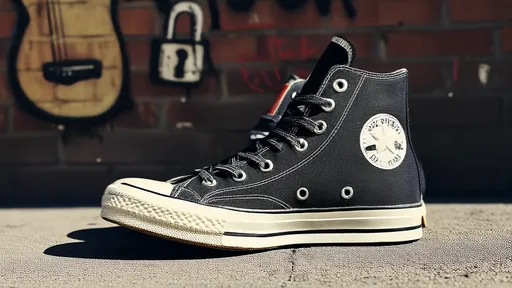
In the dimly lit basements of punk rock clubs and on the cracked pavement of urban basketball courts, Converse sneakers once spoke a language of rebellion. The rubber soles carried the weight of counterculture movements, from Kurt Cobain’s shredded Chuck Taylors to the DIY graffiti splattered across All Stars by underground artists. Yet today, those same shoes shuffle through school hallways, their once-defiant laces now tied neatly by teenagers who might never know their subversive lineage. This is the identity crisis of Converse: a brand that mutated from anti-establishment armor to mass-market uniform, leaving its cultural soul in limbo.
The story begins in 1917, when the Converse Rubber Shoe Company introduced the All Star as a performance basketball shoe. But it wasn’t until Chuck Taylor—a semi-professional player turned salesman—put his name on the ankle patch that the sneaker transcended sports. By the 1950s, black high-tops were uniform for greasers and juvenile delinquents in films like "The Wild One," telegraphing danger with every scuff mark. James Dean wore them off-screen, pairing the shoes with rolled-up blue jeans and a cigarette dangling from his lips. This was footwear as a middle finger to postwar conformity.
Punk rock’s explosion in the 1970s cemented Converse’s outlaw credentials. The Ramones performed in identical black high-tops like a gang uniform, while Debbie Harry of Blondie painted hers with nail polish between CBGB sets. What made Chucks perfect for rebellion wasn’t just their affordability—it was their blank canvas quality. Fans customized them with band logos, anarchist symbols, and safety pins, turning each pair into wearable manifestos. In London, Vivienne Westwood sold customized Converse at her SEX boutique, splattering them with fake blood for the Seditionaries collection. The shoes became shorthand for cultural upheaval.
Somewhere between grunge’s demise and the rise of fast fashion, Converse lost its teeth. The 2003 acquisition by Nike marked a turning point—suddenly, the counterculture staple was part of a corporate behemoth’s portfolio. Department stores stacked rainbow-colored Chuck Taylors next to Disney character pajamas. High school dress codes listed them as acceptable footwear alongside loafers and ballet flats. The very ubiquity that once signaled tribal belonging now rendered them invisible. A 2018 study of Tokyo street style found that 63% of Converse wearers chose them for "neutrality" rather than self-expression—a far cry from their riotous heritage.
Contemporary youth culture’s relationship with Converse reflects this tension. Walk into any American high school today, and you’ll see rows of Chuck Taylors lined up like soldiers—some pristine white, others deliberately dirtied to feign authenticity. The shoes have become what sociologists call "empty signifiers," vessels into which teenagers pour their own meanings. A queer teen might lace theirs with rainbow strings as quiet activism, while their classmate wears the same model unmodified to avoid dress code scrutiny. The symbolism fractures further online, where TikTok teens perform "punk" aesthetics in brand-new Converse purchased from the mall.
Perhaps most telling is the brand’s own marketing whiplash. Recent campaigns awkwardly toggle between nostalgia for its rebellious past ("Made by You" featuring tattoo artists) and pandering to mainstream acceptability (collaborations with Harry Styles). The disconnect manifests physically in products like the Chuck 70, which replicates 1970s construction details but sells primarily to sneakerheads seeking vintage credibility rather than actual rebels. Even the customization options—now available through an app—feel sanitized compared to the X-Acto knife modifications of decades past.
This identity crisis isn’t unique to Converse; it’s the inevitable trajectory of any subcultural symbol absorbed by the mainstream. Doc Martens endured similar dilution when they shifted from skinhead boots to office attire, while band t-shirts became wardrobe staples divorced from their musical origins. What makes Converse’s case particularly poignant is how its democratization erased the very qualities that made it special. The shoes that once required breaking in—both physically and socially—now arrive pre-distressed at Journeys. The canvas that bore witness to underground movements now gets mass-produced in ethical factories, their stitches too perfect to tell real stories.
Yet glimmers of the old spirit persist. In Minneapolis, a collective of punk feminists still screenprints radical slogans on secondhand Chucks. Korean skateboarders in Busan treat their battered pairs as badges of honor. The difference now is that these authentic expressions must compete with a sea of conformity—the same shoes worn by millions who’ve never moshed in a basement or stayed up past curfew. Converse’s greatest irony may be that its success as a canvas for rebellion ultimately made it the default choice for those who never intended to rebel at all.
The question lingers like the smell of rubber in a vintage sneaker shop: Can a symbol retain its power when everyone owns it? As Gen Z navigates fashion’s accelerated cycle of appropriation and exhaustion, Converse stands at a crossroads. Will it fade into background noise like Levi’s 501s, or can it reclaim its edge in an era hungry for authenticity? The answer might lie not in corporate boardrooms, but in the hands of the next generation of misfits—if they’re willing to get their canvas dirty.

By /Aug 21, 2025
By /Aug 13, 2025
By /Aug 13, 2025
By /Aug 13, 2025

By /Aug 13, 2025

By /Aug 13, 2025

By /Aug 13, 2025

By /Aug 13, 2025

By /Aug 13, 2025

By /Aug 13, 2025
By /Aug 13, 2025

By /Aug 13, 2025

By /Aug 13, 2025

By /Aug 13, 2025

By /Aug 13, 2025
By /Aug 13, 2025

By /Aug 13, 2025

By /Aug 13, 2025

By /Aug 13, 2025

By /Aug 13, 2025
