The fashion industry's recent embrace of modular design in clothing – garments with detachable components meant to extend wearability and reduce waste – has encountered an unexpected roadblock. While these innovative designs promise sustainability through mix-and-match versatility, they're creating a new generation of repair challenges that even skilled tailors struggle to address.
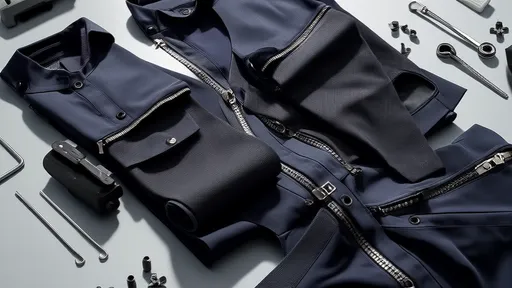
Walk into any modern atelier specializing in garment repairs, and you'll witness the frustration firsthand. "We're seeing jackets where the entire collar zips off, trousers with removable knees that convert to shorts, and dresses with interchangeable sleeves," explains Marco Fiorentini, a third-generation tailor in Milan. "When these connection points fail, the damage often requires complete reconstruction of the assembly mechanism rather than simple stitching." The very features that make these clothes adaptable become their Achilles' heel when repairs are needed.
The problem stems from how modular garments distribute stress across their connection systems. Traditional clothing fails gradually – a seam unravels, a button loosens – allowing for spot repairs. Modular designs concentrate wear at their detachment points, which frequently combine zippers, magnetic clasps, and specialized hook systems. Once these engineered connections degrade, finding replacement parts proves nearly impossible. "Manufacturers consider these proprietary systems," notes London-based sustainable fashion consultant Eleanor Whitmore. "There's no standardized replacement part market like we have for zippers or buttons."
Consumer behavior exacerbates the issue. Market research reveals that most owners of modular garments rarely actually detach and recombine components as intended. The promised versatility remains theoretical while the complex construction makes basic repairs prohibitively expensive. "I had a client bring in a $400 modular parka where the magnetic cuff system failed," shares Brooklyn tailor Javier Ortiz. "Fixing it properly would cost more than half the original price. Most people just abandon the garment."
Some high-end designers are taking notice. Copenhagen-based outerwear brand Nordisk recently abandoned its modular collection after two seasons. "Our repair workshops became assembly line nightmares," admits creative director Lise Kjærgaard. "What looked brilliant on the mood board created disposable clothing in practice." The brand has since shifted to designing with traditional, repairable construction methods while maintaining sustainability through premium natural materials.
Innovative solutions are emerging from unexpected quarters. In Berlin, a collective of fashion students has launched the "Open Source Clothing" initiative, publishing standardized modular connection designs that anyone can manufacture. Meanwhile, several Japanese manufacturers are developing self-reinforcing connection systems that grow stronger with use rather than wearing out. Whether these approaches can scale remains uncertain.
The situation presents a paradox for environmentally conscious consumers. While modular designs theoretically reduce the need to purchase multiple complete garments, their shortened actual lifespan due to repair difficulties may cancel out those benefits. "We're stuck between the promise of modularity and the reality of maintenance," reflects Whitmore. "Until the industry solves this, the most sustainable option might still be a well-made traditional garment you can repair for decades."
As the fashion world races to innovate, the humble needle and thread – technologies thousands of years old – are proving surprisingly difficult to improve upon. The modular design movement now faces its most critical challenge: creating clothing that's as easy to fix as it is to transform.

By /Aug 21, 2025

By /Aug 13, 2025
By /Aug 13, 2025

By /Aug 13, 2025

By /Aug 13, 2025

By /Aug 13, 2025

By /Aug 13, 2025
By /Aug 13, 2025

By /Aug 13, 2025

By /Aug 13, 2025

By /Aug 13, 2025

By /Aug 13, 2025
By /Aug 13, 2025
By /Aug 13, 2025

By /Aug 13, 2025
By /Aug 13, 2025

By /Aug 13, 2025

By /Aug 13, 2025

By /Aug 13, 2025

By /Aug 13, 2025
